

Sustainable mental energy: why energy spikes are not the solution
9 AM. Coffee consumed, agenda open. You're ready to go. By 11 AM, the machine slows down. After lunch, it's a crash. You look for a second coffee, a square of chocolate, something to restart the engine.
This cycle is familiar. It also signifies that your mental energy relies on temporary boosts rather than stable resources.
The difference between these two approaches is not just a matter of comfort. It's a matter of biological mechanism.
Temporary stimulation vs. sustained energy: two different logics
Temporary stimulation works in peaks. Caffeine blocks adenosine receptors, the fatigue molecule, creating a temporary sensation of increased alertness. When the effect wears off, the accumulated adenosine returns with force. This is the midday "crash."
Sustained mental energy works differently. It relies on the brain's ability to maintain its cognitive functions over time, without depending on repeated external stimuli. This implies stable resources: sustained brain energy metabolism, supported stress response, and balanced neurotransmitters.
Source: Ribeiro JA, Sebastião AM. Caffeine and adenosine. Journal of Alzheimer's Disease, 2010.
What biology says about mental energy
The brain constantly consumes glucose and oxygen to maintain its functions. But mental energy is not limited to energy intake. It also depends on the brain's ability to regulate its own activity over time.
Adaptogenic plants get their name from their ability to help the body adapt to stress. Their mechanism of action notably involves supporting the body's natural response to cognitive stress, without a direct stimulating effect. Unlike caffeine, they do not act by blocking a fatigue mechanism. They support the body's natural ability to maintain its resources under pressure, gradually and over time.
Source: Panossian A, Wikman G. Effects of Adaptogens on the Central Nervous System. Pharmaceuticals, 2010.
B vitamins are essential cofactors in cellular energy metabolism. Vitamins B1, B2, B3, B5, and B6 contribute to normal energy metabolism and the normal functioning of the nervous system. These claims are validated by EFSA.
Source: EFSA Panel. Scientific Opinion on Dietary Reference Values for B vitamins. EFSA Journal, 2010.
Why an adaptogenic course changes the approach
An adaptogenic course does not aim to trigger an immediate effect. It is part of a progressive support logic over several weeks.
Some studies on adaptogenic active ingredients document effects on fatigue resistance and stress management after several weeks of regular intake. This is not a stimulation. It is a progressive support of the biological mechanisms involved in managing mental energy.
Source: Olsson EM et al. A randomised, double-blind, placebo-controlled study of Rhodiola rosea SHR-5. Planta Medica, 2009.
The Mental Energy approach
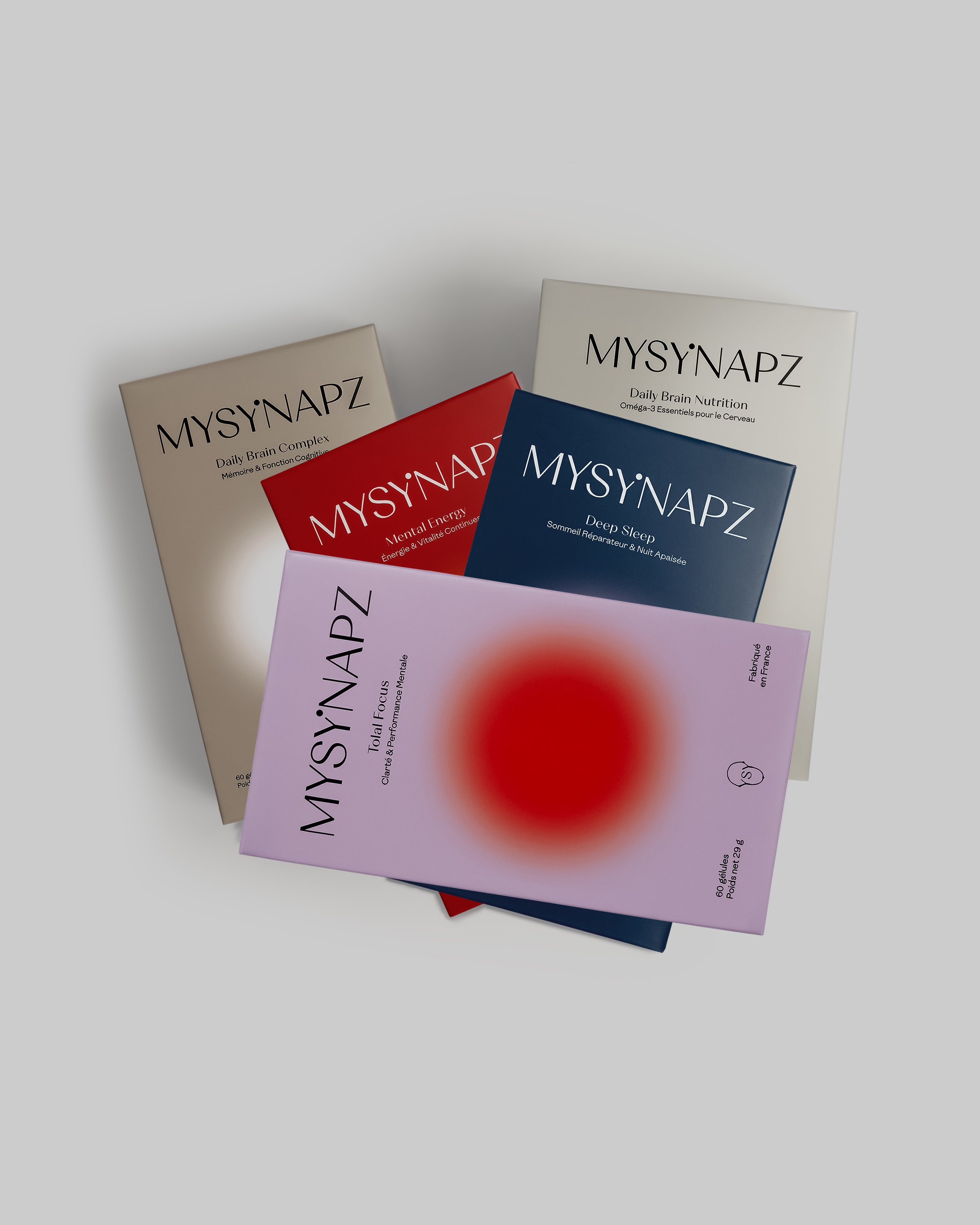
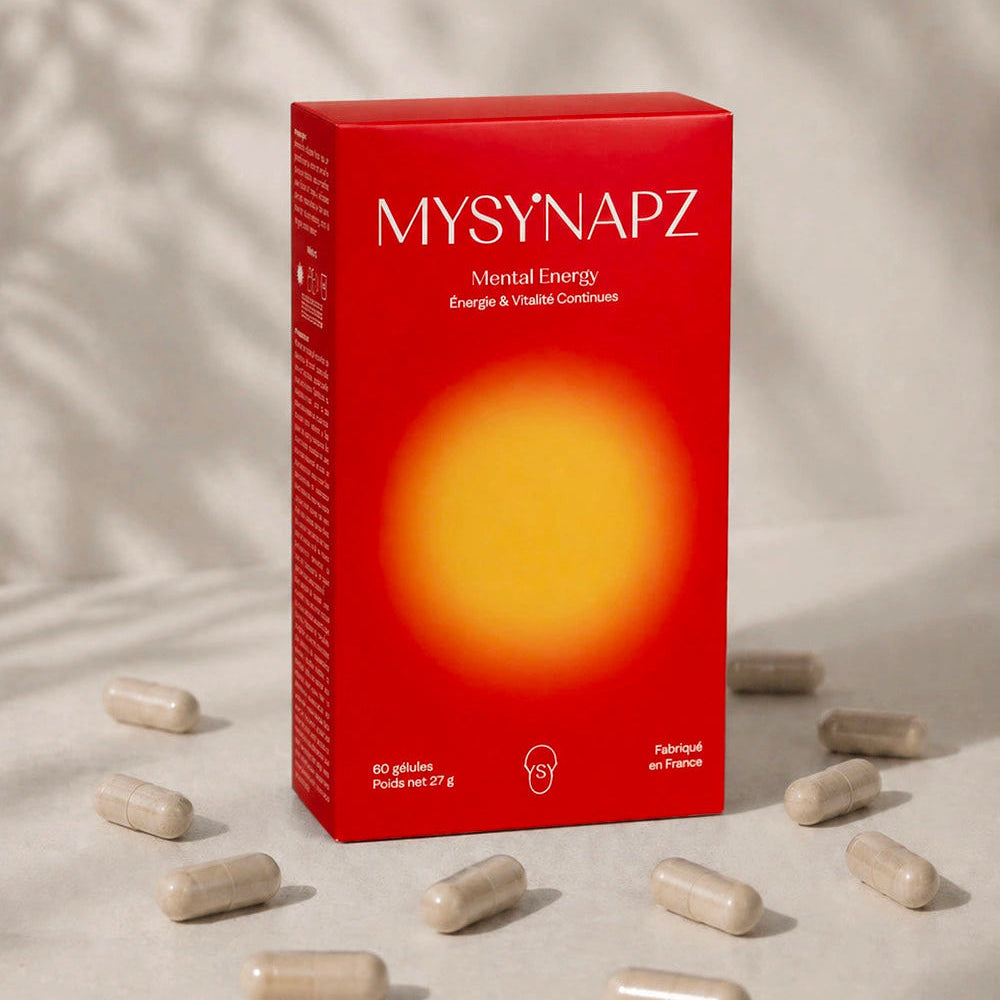
Mental Energy was formulated with this logic in mind: to support more regular mental energy, not to trigger artificial stimulation. The formula combines several families of complementary active ingredients, each with a specific role.
HPMC vegetable capsules · No superfluous excipients · Made in France · 2 capsules in the morning
How a course fits into the long term
Adaptogens act gradually. Some people observe effects on fatigue resistance as early as the first few weeks, others after 3 to 4 weeks of regular intake.
The goal is to support more regular mental energy throughout the day and better resistance to periods of cognitive pressure.
Mental Energy should be taken in the morning, at the beginning of the day. It is not designed for occasional use in case of fatigue, but as part of a regular cognitive routine.
What MySynapz observes
Mental energy is one of the most variable indicators from one profile to another. Some people suffer from chronic underlying fatigue. Others have good energy in the morning but crash in the mid-afternoon. Still others manage normal days well but quickly exhaust themselves under pressure.
The MySynapz method integrates daily monitoring of mental energy to identify these patterns and adapt the approach accordingly.
What is not observed cannot be adjusted.
Mental Energy, MySynapz
Eleutherococcus · Rhodiola · Cordyceps · Guarana
B Vitamins · N-Acetyl L-Carnitine
Discover Mental EnergyFrequently asked questions
Yes, through natural Guarana. Each serving provides about 12 mg of caffeine, significantly less than an espresso. The caffeine from Guarana is associated with other natural compounds that support its absorption, which produces a more gradual effect than isolated anhydrous caffeine.
Yes. Mental Energy is designed for daily intake as part of a routine. It is regularity that allows adaptogens to express their action over time.
Yes, in most cases. The caffeine dose in Mental Energy is low. If you are sensitive to caffeine, prefer to take it before coffee.
Adaptogens act gradually. Some studies suggest effects on fatigue resistance after 2 to 4 weeks of regular intake. Regularity is the most important factor.
Yes. Mental Energy is part of several MySynapz protocols, including Mental Recovery and Brain Reset. The diagnosis will help you identify the most suitable combination for your profile.
Sustainable mental energy cannot be decreed or bought in a shot of caffeine. It is built, gradually, through a routine that supports your brain's biological resources.
Start with your MySynapz diagnosis to identify if mental energy is a priority lever for you.
Scientific sources:
1. Ribeiro JA, Sebastião AM. Caffeine and adenosine. Journal of Alzheimer's Disease, 2010.
2. Panossian A, Wikman G. Effects of Adaptogens on the Central Nervous System. Pharmaceuticals, 2010.
3. Olsson EM et al. A randomised, double-blind, placebo-controlled study of Rhodiola rosea SHR-5. Planta Medica, 2009.
4. EFSA Panel. Scientific Opinion on Dietary Reference Values for B vitamins. EFSA Journal, 2010.
Read more

Exhausted without even moving? It's probably not just one type of fatigue. Here's how to distinguish between physical, mental, and emotional fatigue, and why that changes your recovery strategies.

Coffee, sugar, snack, movement, nap, or Mental Energy: comparison of the options actually available against the 3 PM slump, and why no quick fix alone is enough in the long run.

Discover your cognitive profile and receive personalized recommendations.
A structured approach to better understand the needs of your cognitive functioning and to take concrete action.
Targeted formulas, based on research
Each collection addresses a specific cognitive need (concentration, energy, sleep or emotional balance) by relying on documented ingredients and dosages consistent with available data.