













Memory, mental clarity, concentration: why cognitive needs change after 40
Fuzzy memory, reduced mental clarity, difficulty concentrating: after 40, cognitive needs change. This is not inevitable. Understanding what happens in the brain is the first step to taking action.
You forget where you put your keys. You reread the same sentence twice. You search for a word you knew perfectly well. This is not inevitable. Nor is it necessarily a worrying sign.
It is often a reflection of a more stimulated brain, whose needs evolve over time.
After 40, the brain changes. Not suddenly. Gradually. And these changes have a logic that can be understood and supported.
Memory, mental clarity, and concentration do not disappear overnight. They depend on precise biological mechanisms that can be supported.
What happens in the brain after 40
The brain is not a static organ. It evolves throughout life. After 40, several mechanisms begin to alter its daily functioning.
With age, certain systems involved in attention, working memory, and motivation can become more sensitive to fatigue, stress, and lifestyle variations.
At the same time, DHA reserves, an essential structural fatty acid of the brain, diminish if dietary intake does not compensate. The brain is made up of nearly 60% lipids, of which DHA represents a major structural fraction of neuronal membranes.
- Working memory can become more sensitive to fatigue and stress
- Concentration requires more mental resources
- Cognitive recovery becomes more dependent on sleep and lifestyle
Source: Chang CY et al. Essential fatty acids and human brain. Acta Neurol Taiwan, 2009.
Added to this is an often underestimated reality: at 40, cognitive load is often at its peak. Career, family, projects, decisions. The brain does not rest.
Memory, mental clarity, concentration: three distinct needs
We tend to group these three notions under one word: "the mind". However, they correspond to different cognitive functions, which involve distinct mechanisms.
More specifically, working memory, which allows you to retain information long enough to use it. It depends notably on the quality of synaptic transmission and the intake of choline, a precursor to acetylcholine.
It corresponds to the fluidity of thought, the ability to process information quickly and make decisions without excessive effort. It is very sensitive to sleep quality, low-grade inflammation, and deficiencies in essential micronutrients.
The ability to maintain attention on a task despite distractions notably involves the prefrontal cortex, an area particularly resource-intensive and sensitive to stress and prolonged fatigue.
Source: Arnsten AF. Stress signalling pathways that impair prefrontal cortex structure and function. Nature Reviews Neuroscience, 2009.
Understanding these distinctions changes how one approaches cognitive health. These are precise needs that deserve targeted responses.
What nutrition can do
Several active ingredients are now well-documented for their role in supporting cognitive functions.
A long-chain omega-3 fatty acid, DHA is essential for the structure and function of neuronal membranes. DHA contributes to the maintenance of normal brain function and normal vision, with sufficient daily intake.
Source: EFSA Panel on Dietetic Products, Nutrition and Allergies. Scientific Opinion on DHA. EFSA Journal, 2010.
Also known as citicoline, it is an advanced form of choline particularly studied for its role in supporting memory.
Source: Nakazaki E. et al. Citicoline and Memory Function in Healthy Older Adults: A Randomized, Double-Blind, Placebo-Controlled Clinical Trial. The Journal of Nutrition, 2021.
Lion's Mane has been the subject of studies on its role in supporting cognitive functions, particularly memory and concentration.
Source: Mori K et al. Improving effects of the mushroom Yamabushitake on mild cognitive impairment. Phytotherapy Research, 2009.
An adaptogenic plant used for centuries in Ayurvedic medicine, Bacopa has been studied for its role in supporting memory and information processing speed.
Source: Roodenrys S et al. Chronic effects of Brahmi on human memory. Neuropsychopharmacology, 2002.
Magnesium bisglycinate, Zinc, Iodine, vitamins B9 and B12 also play a recognized role in the normal functioning of the nervous system and cognitive functions.
Identify your cognitive needs in a few minutes.
Memory, concentration, mental energy, sleep: discover your cognitive profile.
Take the free cognitive assessmentThe MySynapz approach
Supporting cognitive health after 40 is not just about taking a dietary supplement.
It's a process that requires understanding one's own needs, choosing the right active ingredients, and observing what changes over time.
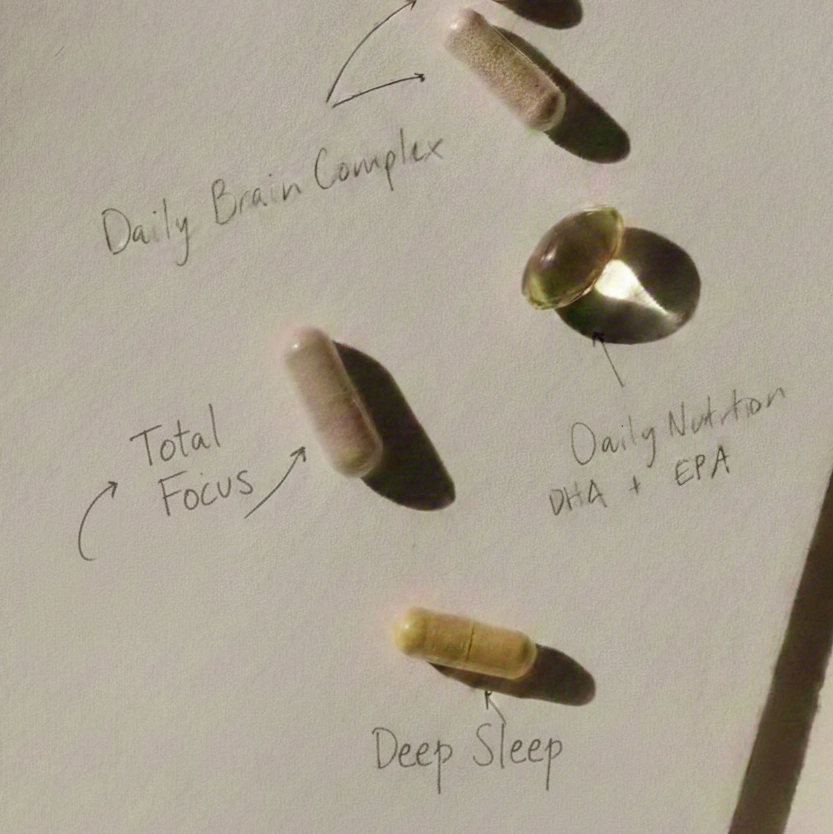
Daily Brain Complex + Daily Brain Nutrition. A course designed to support memory, cognitive functions, and daily brain nutrition.
To observe your progress over time. Because what is not observed cannot be adjusted.
Discover the Brain Foundation protocol
After 40, cognitive needs evolve.
Memory, mental clarity, and concentration do not inevitably decline. They can be supported, provided you understand what your brain needs and act accordingly.
The first step is to know where you stand.
Read more

Energy is finally returning, but staying focused is becoming increasingly difficult. We explain why, and what you can concretely do about it.

Stress, sleep and interruptions: understand concentration difficulties, try practical adjustments and explore MySynapz options.

Discover your cognitive profile and receive personalized recommendations.
A structured approach to better understand the needs of your cognitive functioning and to take concrete action.
Targeted formulas, based on research
Each collection addresses a specific cognitive need (concentration, energy, sleep or emotional balance) by relying on documented ingredients and dosages consistent with available data.